How to read a Japanese auction sheet
A Japanese auction house inspects every car it sells and writes it up on one page. Learn the page and you can judge a car from 10,000 kilometres away.
By Shane Burke · Updated 18 Sept 2026 · Rules version 2026-09-17
What the sheet is
Before a car goes through a Japanese auction, the auction house’s own inspector examines it and produces the auction sheet: an overall grade, an interior grade, the mileage, the chassis and model codes, the equipment, a diagram of the body marked with damage codes, and free-text notes. It is written for dealers bidding sight unseen, so it is blunt.
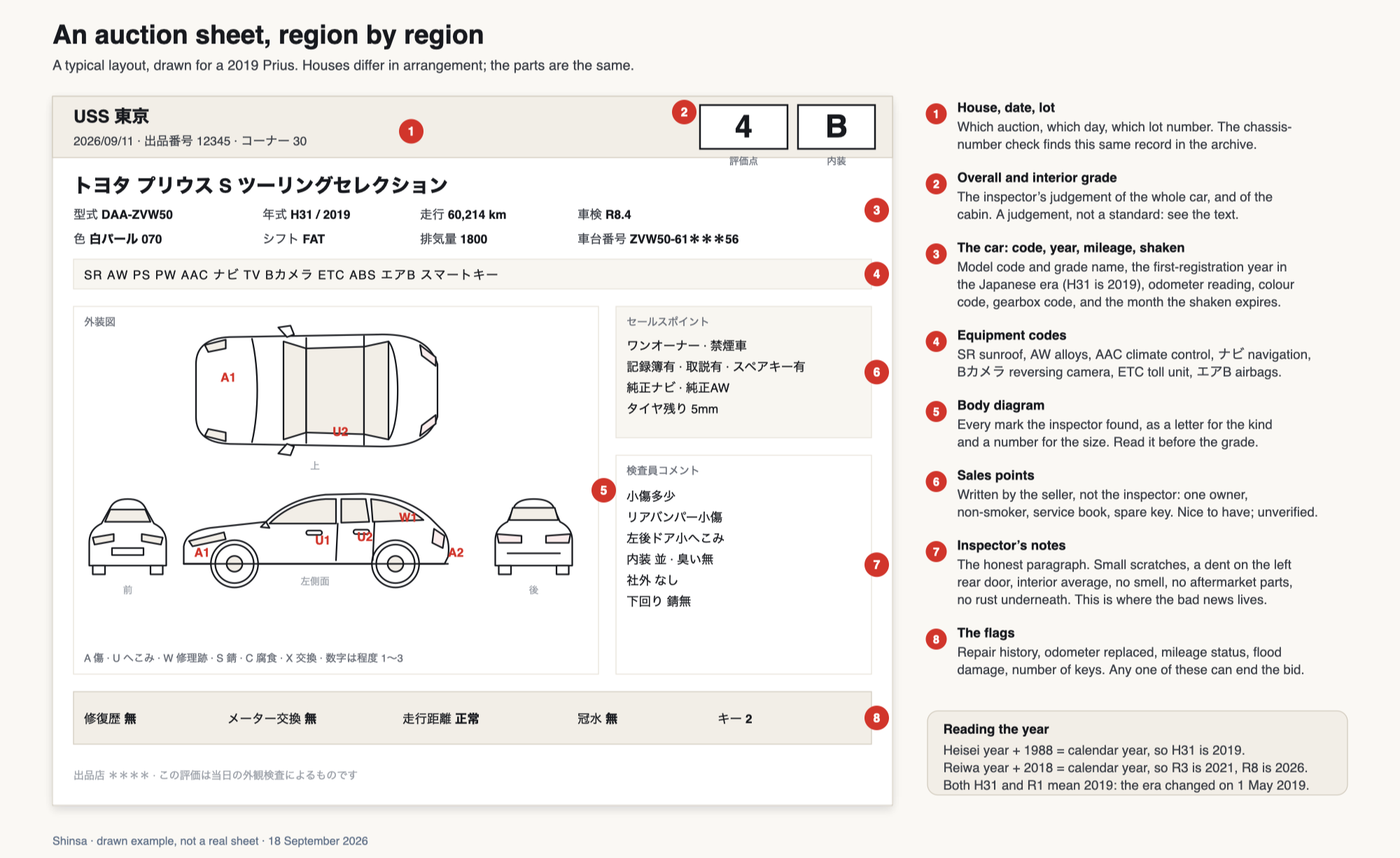
It is also the most honest document in the chain, because the inspector works for the auction house, not the seller. Everything downstream, the exporter’s description, the translation, the listing photos, is derived from it or should be checked against it. The drawing below shows a typical layout; houses arrange the regions differently, but every sheet has all eight.
The header and the car’s details
The top of the sheet names the auction house, the sale date and the lot number, and that trio is how the chassis-number check finds the same record again in the archive. Below it comes the car as the house identifies it: the model name and grade name, then the model code (型式), for example ZVW50 for the fourth-generation Prius, which pins down the generation more reliably than the name does.
The year (年式) is the first registration in Japan, and on most sheets it is written in the Japanese era: H31 for Heisei 31, R3 for Reiwa 3. Heisei plus 1988 gives the calendar year, Reiwa plus 2018 does, and both H31 and R1 mean 2019 because the era changed on 1 May of that year. This is the year Revenue uses for the car’s age and for the 30-year vintage rate, though the month that decides a borderline case is on the export certificate, not the sheet.
The mileage is the odometer reading on the day, in kilometres. Then the colour with the maker’s paint code, the gearbox code (FAT or FA is a floor automatic, CA a column automatic, F5 and F6 five- and six-speed manuals), the engine size in cubic centimetres, and the shaken expiry, the month the car’s Japanese roadworthiness certificate runs out, written R8.4 for April 2026 in the new era. A car with months of shaken left has been driven legally recently; one marked 無 has none, which is common for export stock and is not a fault.
The equipment codes
A row of abbreviations lists what the car has: SR a sunroof, AW alloy wheels, PS and PW power steering and windows, AC air conditioning and AAC climate control, ナビ navigation, TV a television tuner, Bカメラ a reversing camera, ETC the Japanese toll unit, ABS, エアB airbags, 革 leather, and スマートキー keyless entry. Two prefixes matter more than the codes themselves: 純正 means the maker’s own part, 社外 means aftermarket, and 改 means modified. A sheet that says 社外AW and 社外マフラー is describing a car someone has personalised, which insurers and Revenue’s valuation both notice.
The overall grade, and why it is a judgement
The big number is the inspector’s summary of the whole car. Grades run from S down, and the safe zone for an import is 4 and above.
The number is a judgement, not a measurement, and two things follow. First, it is relative to age and mileage: a grade 4 on a 2010 car means “good for a fifteen-year-old car”, not the same thing as a grade 4 on a 2022 car. Second, houses differ. USS, the largest, is generally reckoned the most consistent; smaller houses can be a half-grade more generous, and Toyota’s own TAA and the dealer-group houses have their own habits. A grade 4 at one house may be a 3.5 at another. Read the diagram and the notes before you trust the number, and compare the number only with the same house’s other cars.
- S or 6: nearly new, very low mileage.
- 5: excellent, minimal marks.
- 4.5: very good, light marks only.
- 4: good, some minor scratches or dents. The usual sweet spot for value.
- 3.5: average, visible marks and small dents; fine at the right price, needs a closer look.
- 3: below average; multiple defects.
- R or RA: repair history (修復歴), defined in the next section. RA is lighter, R heavier. Some are fine cars, but they are priced and should be bought as repaired cars.
- ***, 0 or 1: heavily damaged or not running.
What “repair history” actually means
修復歴 has a definition in the Japanese trade, set by the appraisal and fair-trade bodies, and it is narrower than “has been repaired”. A car has repair history when a structural member has been repaired or replaced after damage: the frame or side members, the cross members, the front inside panels, the pillars, the dash panel, the roof panel, the floor panel, the boot floor, and the radiator core support where its replacement came with damage to the structure around it.
Bolt-on panels are not on that list. A replaced bumper, bonnet, wing, door or boot lid, however badly the car was hit, does not by itself make it a repair-history car; it earns an X on the diagram and a lower grade. That is why an R grade is worth taking seriously: it means the shell itself was bent and straightened, and the questions that follow are who did the work and how well. RA is the same definition with lighter damage, often the core support alone. Some houses use only R.
Interior grade and mileage
The interior is graded A to D, A being clean and D worn or smelly; some houses add E. B is normal for a used car. Smoke smell is often noted separately in the inspector’s comments as タバコ臭; ask if it matters to you.
The mileage on the sheet is what the inspector read on the day. A star, a question mark or the note 走行不明 means the house could not vouch for it, usually because the odometer was replaced (メーター交換) or the history has a gap. Treat those cars as unknown mileage and price accordingly, or walk away. The mileage’s real test is not on the sheet at all: the car’s earlier auction appearances, found by chassis number, must show a figure that only ever goes up.
The damage diagram
The car outline is marked with letter codes and a severity number from 1 (small) to 3 (large). The letters are the same at every house; the outline’s style differs.
- A: scratch. A1 is barely visible; A3 needs paint.
- U: dent. U1 is a small ding; U3 is a panel job.
- B: dent with scratch.
- W: previous repair or paintwork. W1 is invisible; W3 is a poor repair with waves in the panel.
- S: rust. C: corrosion. Take either seriously on a car from a snowy prefecture.
- X: a panel that has been replaced. XX: a panel that needs replacing.
- Y: a crack or hole. P: faded paint. G: a stone chip in glass. E: a dimple, often hail.
Sales points, the inspector’s notes and the flags
Two boxes of text sit side by side and come from different people. The sales points (セールスポイント) are written by the seller: one owner (ワンオーナー), non-smoker (禁煙車), service book present (記録簿), owner’s manual (取説), spare key (スペアキー), genuine navigation. They are advertising. Nice to have, unverified, and never a reason to skip the rest of the page.
The inspector’s comments (検査員コメント) are the honest paragraph. Typical entries: 小傷多い many small scratches; 内装並 interior average; リアバンパー小傷 small marks on the rear bumper; エンジン異音 engine noise; オイル漏れ oil leak; 警告灯点灯 a warning light on; 下回り錆 rust underneath; 塩害 salt damage; 冠水 flood damage; 事故現状 sold as an accident car. Any of the last five should end the bid unless the price is a parts price.
The flags along the bottom repeat the questions that matter most in yes-or-no form: repair history, odometer replaced, mileage status, flood damage, and the number of keys. The drawing shows a clean set. A sheet where any of them says 有 (yes) is a different car from the one in the photographs.
Drift cars, grade R and the 改 mark
Drift-prepared cars read differently on a sheet. Expect a low grade or an R, a diagram with corrections on every corner, and a notes box full of 改 (kai, modified) and 社外 (shagai, aftermarket): coil-overs, a limited-slip or welded differential, a bucket seat, a hydraulic handbrake, a cage, an aftermarket turbo. None of that is hidden; it is priced in. What matters is the 修復歴 box and the diagram, because a drifted car with repair history is a repaired shell with a cage over the repair.
Two things to look for specifically. First, the front chassis rails and the strut towers, where the corrections on a drift car concentrate; ask the exporter for photographs of both with the bonnet up before you bid. Second, the engine: a swap is noted when the inspector sees it, and an SR20DET in an S13 that left the factory with a CA18DET, or an RB25DET in an R32, is normal and worth checking against the engine number, because the paperwork and the disclosure for CO2 and NOx follow the car as registered, not the engine in it.
The best drift cars from Japan are often not at the big auctions at all but with specialist yards and dealers, where the sheet is replaced by the dealer’s own description. Treat that description as a listing, not an inspection, and pay for one.
How sheets go wrong
Translations exaggerate in both directions: some describe every A1 as damage, some quietly drop the W3. Read the codes yourself; they are the same on every sheet.
Fraud exists. A seller can send a real sheet from a different car, or a PDF with a better grade typed in. What cannot be faked is the auction house’s own record, which is why the chassis number on the sheet must match the export certificate and the car, and why the sheet should be pulled from an auction-history database rather than accepted as an attachment. The chassis-number guide covers that step.
Finally, the sheet describes the car on the day of the auction. It does not cover mechanical condition beyond obvious notes, so on anything above a commodity price a pre-bid inspection is money well spent.
Try it
Type in the grade, the diagram codes and the notes from your sheet, or photograph it, and have it read against this guide with the red flags pulled out and the calculator filled in.
Open the readerQuestions people ask
What auction grade should I buy?
Grade 4 and above is the safe zone. 3.5 can be good value with a proper look at the diagram and notes. R and RA are repaired accident cars and should be bought knowingly or not at all.
Is a grade 4 the same at every auction house?
No. The grade is the inspector’s judgement, relative to the car’s age, and houses differ by up to half a grade in how generous they are. Compare grades within one house, and read the diagram and the notes before trusting the number.
What does 修復歴 mean, exactly?
Repair history: a structural member has been repaired or replaced after damage, meaning the frame or side members, cross members, inside panels, pillars, dash, roof, floor or boot floor, or the core support with damage around it. Replaced bumpers, bonnets, wings and doors do not count on their own. It is the reason for an R or RA grade.
What is the difference between R and RA?
Both mean repair history under the same definition. RA is the lighter case, often the core support alone; R is more substantial. Some houses use only R. Either way the car is priced as a repaired car and should be inspected as one.
How do I read the year on the sheet?
It is the first registration in Japan in the Japanese era. Add 1988 to a Heisei year and 2018 to a Reiwa year: H31 and R1 are both 2019, R3 is 2021, R8 is 2026. The month, which decides the 30-year vintage rate on a borderline car, is on the export certificate.
Can I trust the mileage on the sheet?
Only if it is not flagged with a star, a question mark or 走行不明, and only once it has been checked against the car’s earlier auction appearances by chassis number, where mileage can only ever go up.
Should I get the sheet translated?
Yes, but read the codes yourself as well. Translations vary in quality and emphasis; the codes do not.
Related
Estimates and guidance only, not tax or legal advice. Points marked as being confirmed are with Revenue or a customs broker in writing before the service opens.